

BMW G80 M3 Horsepower: Performance Figures Revealed

The BMW G80 M3 represents one of the most significant evolutionary leaps in the storied M3 lineage, delivering exceptional power figures that place it firmly among the elite performance sedans of our era. This comprehensive analysis reveals the true performance capabilities of this remarkable machine, examining everything from its potent S58 engine to its various configurations and real-world performance metrics.
Understanding the S58 Powerplant: Engineering Excellence
At the heart of every G80 M3 beats the remarkable S58B30T0 engine, a masterclass in forced induction engineering that represents BMW M's most advanced inline-six powerplant to date. This twin-turbocharged 3.0-liter straight-six engine features cutting-edge technology including dual mono-scroll turbochargers, a closed-deck engine block design for enhanced rigidity, and high-pressure direct fuel injection operating at an impressive 350 bar.
The S58 architecture incorporates several significant improvements over its S55 predecessor, including larger turbochargers with electronically controlled wastegate actuators, a lower 9.3:1 compression ratio optimized for high boost applications, and an advanced 3D-printed cylinder head that optimizes coolant flow and reduces weight. The engine block utilizes a closed-deck design rather than the open-deck configuration of previous generations, providing superior structural integrity under high boost pressures.
BMW engineers equipped the S58 with Valvetronic variable valve lift technology and Double VANOS variable camshaft timing, allowing precise control over air intake across the entire rev range. The forged crankshaft features solidly forged pinions for both the oil pump and camshaft drive chain, contributing to the engine's exceptional durability and rev-happy character. With a redline positioned at 7,200 rpm, the S58 encourages enthusiastic driving while maintaining the smooth, linear power delivery that characterizes the finest BMW inline-six engines.
The comprehensive cooling system represents another engineering highlight, featuring multiple radiators and intercoolers strategically positioned to manage the substantial heat generated by forced induction. This extensive thermal management system ensures consistent performance even during extended track sessions, addressing one of the primary concerns with high-output turbocharged engines.
Standard M3: Pure Performance with Manual Control
The base BMW G80 M3 delivers an impressive 473 horsepower at 6,250 rpm and 406 pound-feet of torque between 2,650 and 6,130 rpm, representing a substantial 48 horsepower increase over the previous F80 generation. Operating with 18.9 psi of boost pressure, this configuration provides thrilling performance while maintaining excellent reliability and drivability for enthusiastic drivers who appreciate traditional manual transmission control.
BMW exclusively offers the standard M3 with a six-speed manual transmission, making it the sole configuration that preserves the three-pedal driving experience. This manual gearbox features rev-matching technology and refined shift action that improves upon the somewhat rubbery feel of previous M3 manual transmissions, though it still doesn't quite match the precision of Honda or Porsche manual gearboxes. The manual transmission pairs exclusively with rear-wheel drive, delivering an engaging, traditional M3 driving experience that purists appreciate.
Performance figures for the manual M3 include a 0-60 mph time of 4.2 seconds and a quarter-mile run of approximately 12.5 seconds, respectable numbers that reflect the slightly lower power output and the inherent time lost during manual gear changes compared to the lightning-quick automatic transmission. Real-world testing consistently shows the manual M3 can exceed these conservative factory claims by several tenths of a second under ideal conditions.
The manual M3 weighs approximately 3,759 pounds (1,705 kg), making it the lightest variant in the lineup thanks to the absence of the heavier automatic transmission and all-wheel-drive hardware. This weight advantage contributes to sharper handling dynamics and a more connected feel through corners, qualities that enthusiast drivers value highly.
M3 Competition: Elevated Performance and Refinement
Step up to the M3 Competition and the performance envelope expands considerably. This variant produces 503 horsepower at 6,250 rpm and 479 pound-feet of torque from 2,750 to 5,500 rpm, achieved primarily through increased boost pressure of 24.7 psi compared to the standard car's 18.9 psi. This represents a 30-horsepower advantage over the base M3 and, more significantly, 73 pound-feet of additional torque that transforms the car's mid-range punch.
The Competition exclusively utilizes an eight-speed M Steptronic transmission with Drivelogic, a torque-converter automatic that delivers lightning-quick shifts while maintaining smoothness in everyday driving situations. This transmission offers multiple modes ranging from efficient cruising to aggressive track-focused shift patterns, allowing drivers to tailor the gearbox behavior to match their driving style and conditions.
In rear-wheel-drive configuration, the M3 Competition accelerates from 0-60 mph in just 3.9 seconds and completes the quarter-mile in 11.6 seconds at 125.6 mph. However, these conservative figures don't tell the complete story, as real-world testing frequently produces times several tenths quicker, with the car often breaking into the high 3.7-second range for 0-60 mph sprints.
The Competition package includes more than just additional power. BMW equips these models with specifically calibrated adaptive M suspension featuring revised spring rates and damper settings, providing a noticeably firmer yet still compliant ride that enhances body control during spirited driving. The electronically controlled Active M differential at the rear axle optimizes traction and handling by varying the degree of lock based on driving conditions and driver inputs.
Weight for the rear-drive Competition increases to approximately 3,890 pounds (1,765 kg) due to the automatic transmission and additional equipment, yet the added power more than compensates for this modest weight gain. The Competition also benefits from unique styling elements including high-gloss black exterior trim, model-specific wheels, and subtle aerodynamic enhancements.
M3 Competition xDrive: All-Weather Dominance
The M3 Competition xDrive takes the already impressive Competition formula and adds BMW's intelligent all-wheel-drive system, creating what many consider the most capable M3 variant for real-world driving conditions. The 2024 model year xDrive shares the same 503 horsepower and 479 pound-feet specifications as the rear-drive Competition.
BMW's M xDrive system represents a sophisticated approach to all-wheel drive, featuring an electronically controlled multi-plate clutch that continuously varies torque distribution between the front and rear axles. The system primarily sends power to the rear wheels, only engaging the front axle when necessary for traction. Drivers can select from three distinct modes: 4WD provides maximum traction for challenging conditions, 4WD Sport delivers a more rear-biased setup for spirited driving, and 2WD mode completely disengages the front axle for traditional rear-wheel-drive dynamics.
The all-wheel-drive system transforms the M3's acceleration capabilities. Where the rear-drive Competition can struggle to put power down from a standstill due to wheelspin, the xDrive variant simply hooks up and goes. The 2024 xDrive model achieves 0-60 mph in a supercar-rivaling 3.5 seconds, with the quarter-mile dispatched in 11.3 seconds at 121 mph. These represent substantial improvements of 0.4 and 0.3 seconds respectively over the rear-drive Competition in the sprint to 60 mph and quarter-mile.
Real-world testing reveals even more impressive performance potential. Car and Driver achieved a remarkable 2.8-second 0-60 mph time with the xDrive Competition, placing it in genuine supercar territory and matching vehicles costing significantly more. The quarter-mile time dropped to 11.0 seconds at 124 mph in their testing, demonstrating the effectiveness of the all-wheel-drive traction advantage.
For 2025, BMW enhanced the xDrive Competition with a significant power increase, boosting output to 523 horsepower while maintaining the same 479 pound-feet of torque. Peak torque now extends to 5,730 rpm rather than 5,500 rpm, providing stronger pull in the upper rev range. These upgrades came through optimized engine management software rather than mechanical changes, demonstrating the impressive capability engineered into the S58 platform from inception.
The 2025 xDrive model maintains the impressive acceleration figures of its predecessor while providing even more mid-range punch and top-end power. The official 0-60 mph time remains 3.5 seconds, though real-world testing suggests the additional 20 horsepower should produce times approaching or matching the 2.8-second runs achieved with the previous model under ideal conditions.
Weight for the xDrive configuration increases to approximately 3,990 pounds (1,810 kg), roughly 100 pounds more than the rear-drive Competition due to the additional all-wheel-drive hardware. This weight concentrates primarily over the front axle, slightly altering the weight distribution compared to rear-drive models. However, the traction benefits far outweigh any handling compromises, and the selectable 2WD mode allows drivers to experience pure rear-drive dynamics when conditions permit.
M3 CS: The Ultimate Expression
Positioned at the pinnacle of the G80 M3 range sits the M3 CS (Club Sport), a limited-production variant that extracts maximum performance from the S58 engine. The CS produces an impressive 543 horsepower at 6,250 rpm, achieved through increased boost pressure of 30.5 psi compared to the Competition's 24.7 psi. Torque remains at 479 pound-feet but is now available from 2,750 to an extended 5,950 rpm, providing exceptional mid-range and top-end performance.
The substantial power increase of 40 horsepower over the standard Competition required targeted modifications including raising the maximum charge pressure from 1.7 bar to 2.1 bar on the dual mono-scroll turbochargers and implementing model-specific engine management calibrations. These changes transform the CS into a truly special performance machine that challenges vehicles costing substantially more.
BMW equipped the M3 CS exclusively with M xDrive all-wheel drive and the eight-speed M Steptronic transmission, optimized with gearbox mapping borrowed from the even more hardcore M4 CSL. The CS sprints from 0-60 mph in just 3.4 seconds, and with the optional M Driver's Package, the electronic speed limiter increases from 155 mph to an impressive 188 mph.
Weight reduction played a crucial role in the CS formula. Through the use of carbon fiber components including the roof, hood with prominent center bulge, front splitter, rear diffuser, and trunk lid, plus lightweight forged wheels and reduced sound deadening, the CS sheds approximately 75 pounds compared to the standard Competition xDrive. At 4,057 pounds (1,840 kg), the CS remains substantial but maximizes the power-to-weight ratio within the G80 platform.
The M3 CS features extensive track-focused enhancements beyond just power and weight savings. The Adaptive M suspension receives CS-specific tuning with revised spring rates and damper settings for improved body control during hard cornering. The car wears wider front and rear tracks with staggered tire sizes of 275/35R19 front and 285/30R20 rear, providing exceptional grip. Optional carbon-ceramic brakes offer fade-resistant stopping power for track use while reducing unsprung weight.
Visual differentiation includes CS-specific aerodynamic elements, unique badging, distinctive paint options, and an interior featuring lightweight bucket seats and extensive use of carbon fiber and Alcantara trim. The CS represents the ultimate street-legal M3, balancing track capability with everyday usability.
Real-World Performance: Beyond the Numbers
While manufacturer specifications provide important baseline data, real-world performance testing reveals the true capabilities of the G80 M3 lineup. Multiple independent tests confirm BMW's tendency to underrate their performance figures, with actual acceleration times frequently exceeding official claims.
The rear-wheel-drive Competition consistently achieves 0-60 mph times in the mid-to-high 3-second range under optimal conditions, despite BMW's conservative 3.9-second claim. Quarter-mile testing at prepared drag strips regularly produces times between 11.4 and 11.6 seconds with trap speeds ranging from 121 to 126 mph. The variation depends primarily on surface conditions, temperature, and driver skill in managing the launch control system.
The xDrive Competition demonstrates even more impressive real-world performance. Car and Driver's testing achieved that remarkable 2.8-second 0-60 mph time and 11.0-second quarter-mile at 124 mph, figures that place it among the quickest sedans available at any price. Multiple owners report consistent quarter-mile times in the 11.2 to 11.3-second range with minimal preparation.
Rolling acceleration proves equally impressive across the lineup. The 60-130 mph test, increasingly relevant for real-world highway performance, showcases the S58 engine's exceptional mid-range torque and top-end power delivery. Stock M3 Competition xDrive models regularly achieve times in the 6-7 second range for this benchmark, competing with vehicles producing significantly more power.
Braking performance matches the acceleration capability. The standard steel brake package provides excellent stopping power, with 60-0 mph braking distances ranging from 102 to 108 feet depending on conditions and tire choice. The optional carbon-ceramic brakes offer even better performance with 60-0 mph stops in approximately 100 feet while providing superior resistance to fade during track use.
Lateral grip figures of 1.03g on the skidpad demonstrate exceptional cornering capability, supported by the wide stance, advanced suspension geometry, and high-performance tire packages. The electronic stability control system allows experienced drivers to explore the limits while providing a safety net, and the adjustable M Traction Control offers 10 stages of intervention for track use.
Fuel economy, while not the primary concern for M3 buyers, proves surprisingly reasonable given the performance on offer. EPA ratings of 16 city, 22-23 highway, and 18-19 combined mpg represent the official figures. Real-world highway testing at a steady 75 mph produces remarkable results of 27-32 mpg, with the automatic transmission models achieving the higher end of this range. In spirited driving, expect consumption to drop to 15-17 mpg, a reasonable tradeoff for the performance delivered.
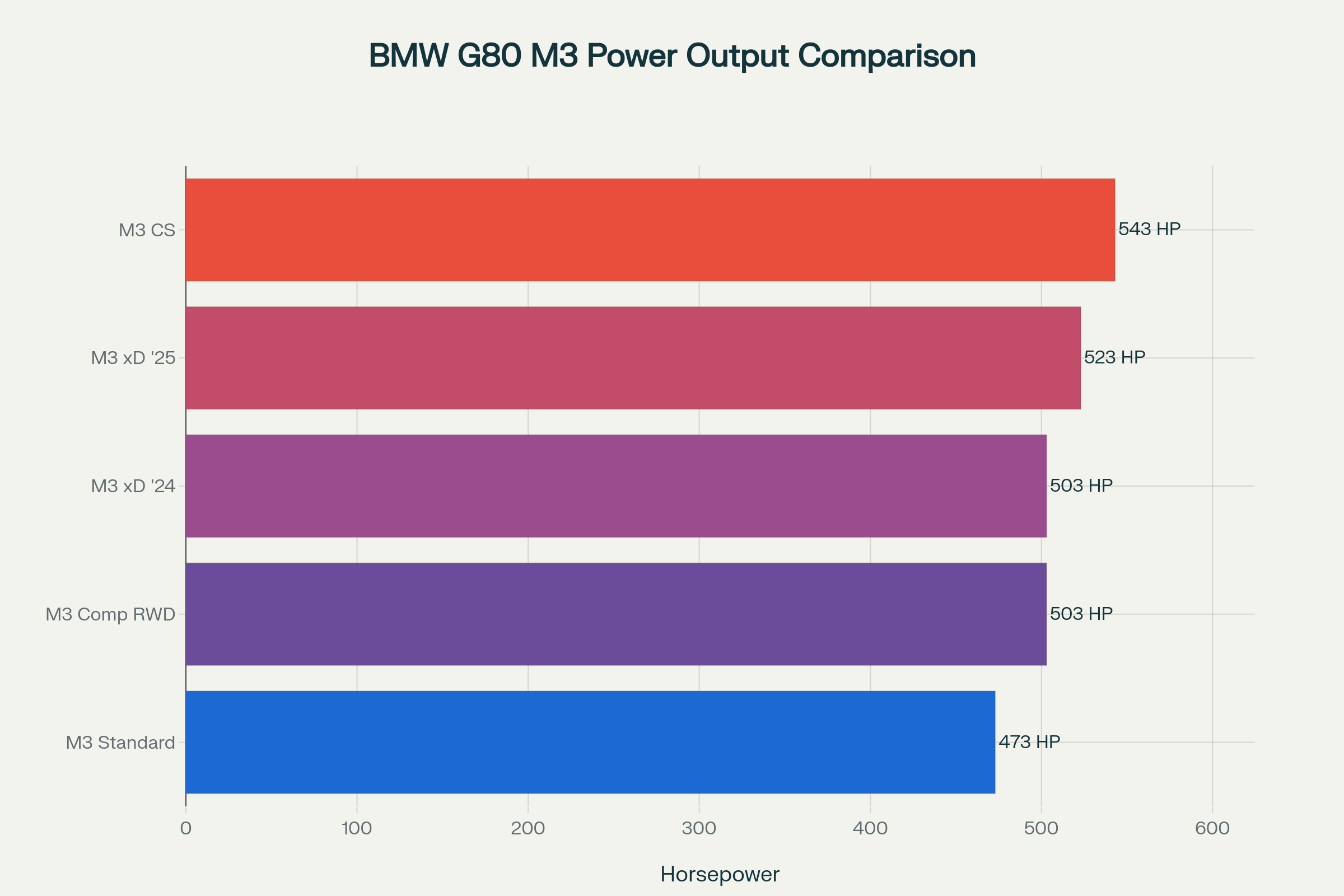
Horsepower comparison across all BMW G80 M3 variants, showing the progression from the base model to the high-performance CS variant
Transmission Options: Manual Versus Automatic Excellence
The choice between the manual and automatic transmissions represents one of the most significant decisions for M3 buyers, fundamentally altering the character and capability of the vehicle. Each option offers distinct advantages that appeal to different priorities and driving styles.
The six-speed manual transmission available exclusively in the base M3 provides an increasingly rare opportunity to experience traditional three-pedal driving in a modern high-performance sedan. This gearbox features welcome modern conveniences including automatic rev-matching that can be disabled for purists who prefer heel-toe downshifting, and hill-start assist that prevents rollback on inclines.
BMW significantly improved the shift action compared to previous generations, though some reviewers note the shifter still exhibits a slightly rubbery feel compared to the best manual gearboxes from Honda or Porsche. The shift throws are relatively short and direct, and the clutch pedal provides good feedback with a manageable engagement point that doesn't become fatiguing in traffic.
Performance with the manual transmission inevitably lags behind the automatic due to time lost during gear changes and the difficulty of executing perfect shifts under full throttle. The manual M3 achieves 0-60 mph in 4.2 seconds compared to 3.9 seconds for the rear-drive Competition automatic, and quarter-mile times trail by approximately one second. However, many enthusiasts willingly accept this performance penalty in exchange for the greater engagement and satisfaction of rowing your own gears.
The manual transmission also impacts launch control functionality. To manage wheelspin with the less powerful 473-horsepower output and rear-wheel drive, the manual M3's launch control initiates from second gear rather than first, sacrificing some initial acceleration for improved traction. This represents a fascinating technical solution to the traction challenges inherent in rear-drive turbocharged performance.
The eight-speed M Steptronic automatic transmission fitted to Competition models represents the pinnacle of torque-converter automatic technology. Unlike dual-clutch transmissions that can exhibit jerkiness in low-speed situations, this conventional automatic provides smooth, imperceptible shifts during relaxed driving while delivering lightning-quick changes under full throttle.
The Drivelogic system offers three distinct shift programs accessible through steering wheel paddles or the gear selector. In its most aggressive setting, shifts occur in less than 150 milliseconds, rivaling or exceeding dual-clutch transmission speeds while maintaining the smoothness and durability advantages of torque-converter design. The transmission also features an exceptionally wide ratio spread that optimizes both acceleration and cruising efficiency.
Launch control functionality with the automatic proves devastatingly effective. The system manages engine speed, clutch engagement, and power delivery to optimize traction, consistently producing repeatable acceleration runs that maximize the available grip. The xDrive variants particularly benefit, with the all-wheel-drive system eliminating almost all wheelspin and enabling those remarkable sub-3-second 0-60 mph times.
Fuel economy favors the automatic transmission, with the Competition models typically achieving 1-2 mpg better than the manual in both city and highway driving. The torque converter's ability to lock up at cruising speeds eliminates slippage losses while providing smooth operation in traffic, contributing to both efficiency and refinement.
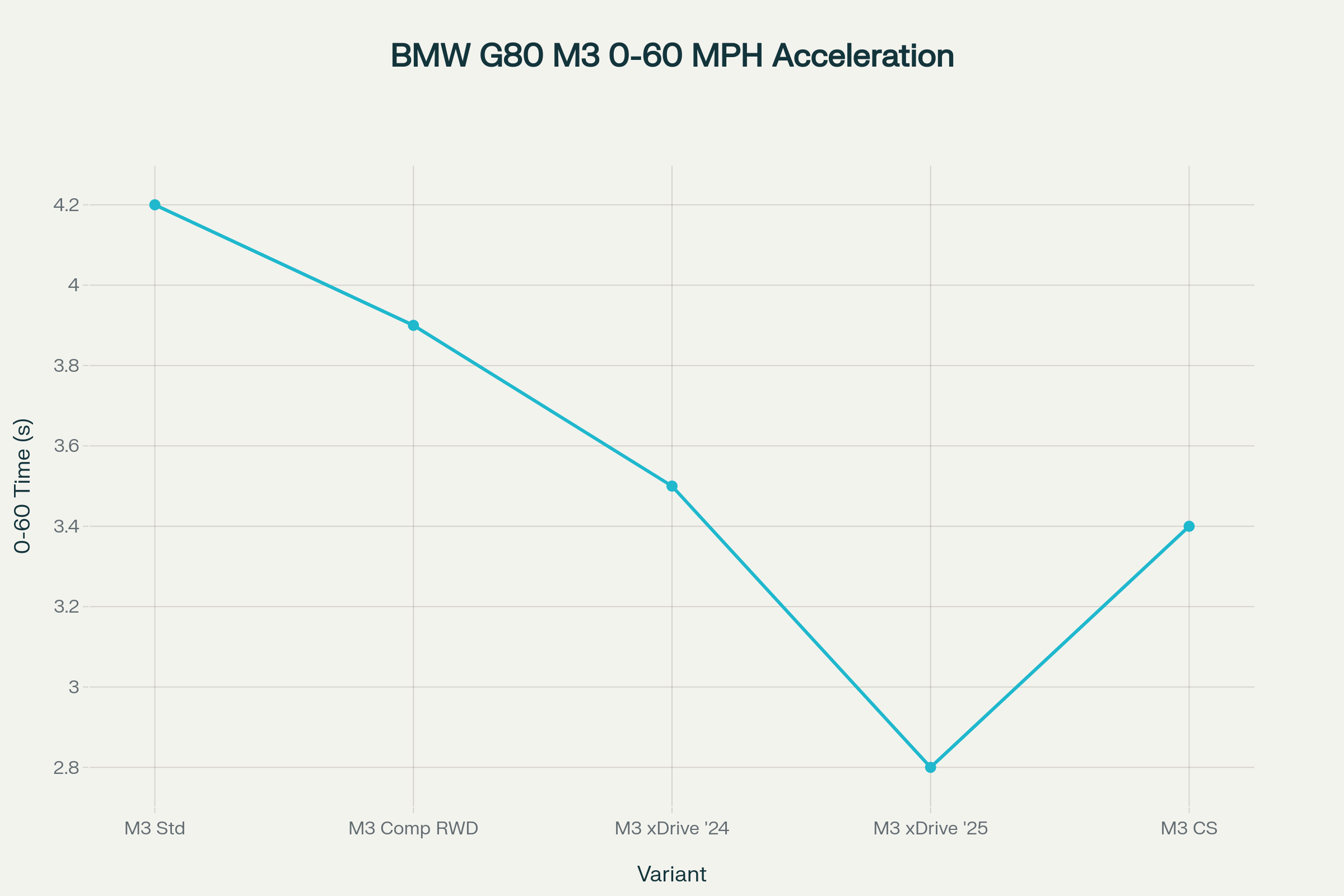
Acceleration performance comparison showing 0-60 mph times across BMW G80 M3 variants, with the 2025 xDrive achieving the fastest time
Weight Distribution and Chassis Dynamics
The G80 M3's performance credentials extend beyond raw horsepower figures to encompass exceptional chassis dynamics and handling balance. BMW's engineers invested considerable effort optimizing weight distribution, suspension geometry, and structural rigidity to create a sedan that excels on both road and track.
The standard manual M3's curb weight of approximately 3,759 pounds (1,705 kg) makes it the lightest variant, with weight distributed to optimize rear-drive dynamics. The Competition models add roughly 130 pounds due to the automatic transmission and additional equipment, bringing curb weight to approximately 3,890 pounds for rear-drive versions. The xDrive configuration adds another 100 pounds concentrated primarily over the front axle due to the additional all-wheel-drive components, resulting in a curb weight near 3,990 pounds.
Despite this weight, which represents a significant increase over previous M3 generations, the G80 delivers exceptional handling characteristics. The adaptive M suspension system features double-wishbone front suspension with ball joints instead of rubber bushings for increased precision, and a multi-link rear setup that provides excellent geometry control under acceleration and cornering loads.
BMW fitted the M3 with electronically controlled adaptive dampers that adjust compression and rebound rates in real-time based on road conditions, driving mode, and driver inputs. The system offers Comfort, Sport, and Sport Plus settings, with the latter providing track-ready firmness while the Comfort mode maintains surprising compliance over rough pavement.
The wide track dimensions contribute significantly to stability and cornering capability. The M3 features a front track of 63.7 inches and rear track of 63.2 inches, substantially wider than the standard 3-Series to accommodate larger tires and improved geometry. This width combines with a relatively low center of gravity and near-50/50 weight distribution to deliver exceptional balance through corners.
The Active M differential at the rear axle represents another crucial dynamic element. This electronically controlled limited-slip differential continuously varies the degree of lock from fully open to fully locked based on steering angle, throttle position, lateral acceleration, and wheel speeds. The system optimizes traction during corner exit while maintaining stability and predictability, allowing drivers to exploit the available grip with confidence.
The G80's structural rigidity benefits from extensive use of aluminum and ultra-high-strength steels in strategic locations throughout the body structure. This stiffness provides a solid foundation for the suspension to work effectively, eliminating flex that would compromise handling precision. Carbon fiber roof panels on most variants lower the center of gravity while reducing weight in the highest location.
Steering response receives almost universal praise from reviewers. The electromechanical power steering system provides excellent feedback and natural weighting that builds progressively with cornering forces. While some purists lament the loss of pure hydraulic steering feel, the G80's system represents a significant improvement over previous BMW electric power steering implementations and ranks among the best in the segment.
Aerodynamic Development and Track Performance
BMW's M division invested heavily in aerodynamic development for the G80 M3, optimizing both drag reduction for efficiency and downforce generation for high-speed stability. The controversial large kidney grille design, while polarizing aesthetically, serves crucial functional purposes in cooling the high-output S58 engine and providing air to the various heat exchangers.
The front fascia incorporates carefully sculpted air curtains that channel airflow around the front wheels, reducing turbulence and aerodynamic drag while contributing downforce to the front axle. Three small vertical flicks inside each air curtain further enhance front downforce, working in concert with the prominent front splitter to generate negative pressure beneath the nose.
The underbody design features an increasingly raised floor section towards the rear axle, creating a gentle diffuser effect that increases downforce without significant drag penalty. This approach, combined with the aggressive rear diffuser, helps balance aerodynamic forces front and rear while maintaining stability at high speeds.
At 180 mph (290 km/h), the standard M3 generates approximately 620 Newtons of lift at the front axle and 620 Newtons of downforce at the rear axle. While the front remains in slight lift territory, this represents a significant improvement over previous generations and provides adequate balance for stable high-speed driving. Aftermarket aerodynamic packages can generate substantially more downforce, with some kits producing over 2,500 pounds (1,100 kg) at 180 mph.
Track performance capabilities extend well beyond the impressive acceleration figures. The M3's combination of power, handling, and braking allows it to achieve remarkable lap times on circuits worldwide. At the legendary Nürburgring Nordschleife, the M3 CS recorded a lap time of 7:28.760, an exceptional figure that places it among the quickest sedans to tackle the challenging 12.9-mile circuit.
Various owners have reported track lap times at facilities ranging from local road courses to premier international circuits. Common feedback emphasizes the M3's ability to maintain consistent performance lap after lap, with the comprehensive cooling systems managing temperatures effectively even during extended sessions. The optional carbon-ceramic brakes prove particularly valuable on track, providing fade-free stopping power while reducing unsprung weight for improved suspension response.
The M Drive Professional package enhances track capabilities with features including M Track Mode that reduces electronic intervention, M Laptimer for recording and analyzing circuit performance, M Traction Control offering 10 stages of adjustability, and M Drift Analyzer that scores and records drift angles and duration. These systems transform the M3 into a capable teaching tool that helps drivers improve their skills progressively.
Interior Refinement and Technology Integration
Beyond its formidable performance capabilities, the G80 M3 provides a remarkably refined interior environment that balances sporting character with daily usability. BMW equipped the cabin with premium materials, advanced technology, and thoughtful ergonomics that make the M3 equally comfortable navigating daily commutes or attacking canyon roads.
The driver-focused cockpit features heavily bolstered sport seats that provide excellent support during aggressive driving while maintaining comfort over long distances. The seats offer extensive adjustment including lumbar support, thigh support, and side bolster adjustment, allowing drivers of various sizes to achieve an optimal seating position. Heated and ventilated functions provide climate comfort across all seasons.
The M-specific steering wheel incorporates prominent red M1 and M2 buttons that allow instant recall of pre-configured driving modes encompassing powertrain, suspension, steering, and stability control settings. This feature enables drivers to optimize the car's character for different conditions or preferences with a single button press rather than navigating through multiple menu screens.
For 2023 and later model years, BMW introduced iDrive 8 operating system featuring a curved display that integrates a 12.3-inch digital instrument cluster and 14.9-inch central touchscreen. This latest infotainment generation offers enhanced graphics, improved voice recognition through the BMW Intelligent Personal Assistant, and wireless Apple CarPlay and Android Auto integration.
The iDrive 8 system includes M-specific display modes that showcase performance-relevant information including turbo boost pressure, oil temperature, g-force readings, and lap timing data. The customizable widgets allow drivers to prioritize the information most relevant to their driving style, and the M colors integrate throughout the interface to reinforce the sporting character.
Sound quality receives attention through the available Harman Kardon surround sound system featuring 16 speakers and 464 watts of amplification. This premium audio system delivers excellent clarity and dynamics whether enjoying music during cruising or appreciating the S58 engine's mechanical symphony through the active sound control system.
Storage and practicality remain strong despite the performance focus. The trunk provides 16.9 cubic feet of cargo space, sufficient for weekend trips or daily errands. The rear seats accommodate adults comfortably on shorter journeys, and the 60/40 split folding rear seatbacks allow transport of longer items when necessary. This usability distinguishes the M3 from two-seat sports cars, making it genuinely viable as an only car for enthusiasts who refuse to compromise on performance.
Climate control maintains comfort through a three-zone automatic system that independently regulates temperature for the driver, passenger, and rear occupants. The system integrates with the GPS to pre-condition the cabin based on sun position and outside temperature, ensuring optimal comfort without driver intervention.
Design Evolution and Exterior Styling
The G80 M3's exterior design sparked immediate controversy upon its 2020 debut, primarily due to the dramatically enlarged kidney grille that breaks from decades of BMW design tradition. However, the polarizing styling serves functional purposes while creating unmistakable road presence that ensures the M3 stands out in any environment.
The massive vertical grille openings provide substantially increased cooling capacity for the 503-543 horsepower S58 engine and its supporting systems. The enlarged apertures direct air to the radiators, intercoolers, transmission cooler, and various other heat exchangers essential for maintaining performance during extended high-load operation. BMW's aerodynamics team shaped every element to minimize drag while maximizing cooling efficiency.
Beyond the grille, the M3 incorporates numerous design elements that distinguish it from standard 3-Series models. The dramatically flared wheel arches accommodate the wider track and larger wheels, creating an aggressive stance that communicates performance capability even at rest. The front fascia features large air intakes and prominent splitter elements that channel airflow while generating downforce.
The side profile showcases sculpted character lines that emphasize the M3's muscular proportions. Black side gills behind the front wheels pay homage to historical M car designs while serving aerodynamic functions. The Competition models feature high-gloss black exterior trim on the mirror caps, window surrounds, and grille surround that creates visual contrast.
At the rear, the M3 displays quad exhaust outlets integrated into the aggressive rear diffuser, a signature M car styling element that also serves aerodynamic purposes. The subtle trunk lid spoiler lip enhances rear downforce without excessive visual drama. The rear fascia continues the sculpted, muscular theme established at the front, with sharp angles and defined surfaces that catch light dynamically.
BMW offers the G80 M3 in an extensive palette of colors ranging from classic solid finishes to metallic and the premium Frozen matte paint options. Popular choices include Isle of Man Green, a launch color exclusive to M3 and M4 models that proved extremely popular. Portimao Blue Metallic offers a striking blue hue that references BMW M's motorsport heritage. Sao Paulo Yellow provides high-visibility vibrancy at no additional charge, while Toronto Red Metallic delivers classic sports car appeal.
The Individual paint program extends the color selection dramatically, offering unique finishes including Fire Orange, Urban Green, Twilight Purple Metallic, Brass Metallic, and various Frozen matte options. These special finishes command premium pricing but allow owners to create truly distinctive vehicles that reflect personal style.
Wheel options range from 19-inch front and 20-inch rear forged alloys in various designs, all engineered to reduce unsprung weight while providing the strength required for high-performance driving. The staggered tire setup typically features 275/35R19 front and 285/30R20 rear performance rubber from premium manufacturers including Michelin Pilot Sport 4S, Pirelli P Zero, or Michelin Pilot Sport Cup 2 for track-focused applications.
Tuning Potential and Aftermarket Performance
The S58 engine's robust design and conservative factory tuning leave substantial performance on the table, making the G80 M3 an exceptional platform for enthusiasts seeking additional power. Reputable tuners consistently extract 80-100 additional horsepower and over 100 pound-feet of torque through software optimization alone, with supporting modifications enabling even more dramatic gains.
Stage 1 tuning packages typically involve ECU software modifications that optimize fuel delivery, ignition timing, boost pressure, and transmission shift parameters. These calibrations unlock the S58's true potential while maintaining reliability and drivability, with gains bringing the standard Competition to approximately 600 wheel horsepower. Multiple tuning companies offer these services including Bootmod3, aFe Performance, ESS Tuning, and Burger Motorsports with their popular JB4 piggyback system.
Combined with supporting modifications including high-flow downpipes (for off-road use), upgraded intercoolers, and performance air intakes, Stage 2 tuning packages push power levels toward 700 horsepower at the crank. These modifications require careful attention to supporting systems including the cooling system, fuel delivery, and transmission to ensure reliability at elevated power levels.
The eight-speed automatic transmission responds well to TCU (transmission control unit) tuning that increases line pressure, quickens shift speeds, and raises torque limits. These calibrations complement engine tuning by ensuring the transmission can reliably handle increased power while delivering even more aggressive shift characteristics.
Some enthusiasts pursue even more extreme builds with upgraded turbochargers, built engines featuring forged pistons and connecting rods, and comprehensive supporting modifications. These projects can achieve 1,000+ horsepower, transforming the M3 into a genuine supercar-slaying weapon capable of sub-10-second quarter-mile times. However, such builds require significant investment and compromise daily drivability.
Beyond engine performance, the G80 platform offers extensive opportunities for chassis enhancement. Coilover suspension systems from manufacturers including KW Suspension provide adjustable height and damping that allow precise tuning for street or track applications. Upgraded sway bars, control arms with adjustable spherical bearings, and camber plates further optimize handling geometry.
Brake upgrades prove worthwhile for track-focused use, with packages from Brembo, Girodisc, and others providing larger rotors, stronger calipers, and improved cooling. Performance pad compounds from manufacturers including Pagid, Carbotech, and Ferodo significantly increase friction and fade resistance compared to the already-capable factory brake system.
Aerodynamic enhancements allow owners to achieve greater downforce for track use. Front splitters, rear wings, side skirts, and rear diffusers from companies including Revozport, AutoTecknic, and others not only transform the visual appearance but generate measurable aerodynamic loads that improve high-speed stability and cornering grip.
Weight reduction represents another popular modification path. Lightweight wheels, carbon fiber body panels, rear seat deletion, and lightweight batteries can collectively save 100+ pounds, improving acceleration, handling, and braking while maintaining structural integrity. The CS model demonstrates BMW's own weight reduction philosophy, though its limited production and premium pricing make it unavailable to most buyers.
Competitive Landscape and Market Positioning
The BMW G80 M3 competes in the ultra-competitive performance sedan segment against formidable rivals including the Mercedes-AMG C63, Audi RS4/RS5, Cadillac CT4-V Blackwing, and Alfa Romeo Giulia Quadrifoglio. Each competitor brings distinct character and capabilities, making the choice among them largely dependent on personal priorities and preferences.
The latest Mercedes-AMG C63 S E Performance takes a radical approach with its 2.0-liter turbocharged four-cylinder engine paired with a powerful electric motor for combined outputs of 671 horsepower and 752 pound-feet of torque. This hybrid powertrain delivers exceptional performance with 0-60 mph times matching the M3 Competition xDrive, though the C63's 4,783-pound curb weight represents a substantial 800-pound penalty that impacts handling dynamics.
Pricing for the Mercedes-AMG C63 S E Performance starts around $100,000 USD in markets where available, positioning it at a premium compared to the M3 Competition xDrive's approximately $88,000 starting price. The Mercedes counters with extensive standard equipment and the novelty of its hybrid technology, though some enthusiasts lament the loss of the legendary 4.0-liter twin-turbo V8 that powered previous C63 generations.
The Audi RS5 Sportback offers a more traditional approach with its 2.9-liter twin-turbocharged V6 producing 444 horsepower and 442 pound-feet of torque. This represents a significant power disadvantage compared to the 503-523 horsepower M3 Competition, reflected in a slower 0-60 mph time of 4.1 seconds. However, the Audi compensates with its stunning five-door fastback design that provides exceptional practicality, sophisticated interior, and Audi's legendary quattro all-wheel-drive system.
Pricing for the RS5 typically undercuts the M3 Competition by several thousand dollars, and the related RS4 Avant wagon offers even greater versatility for buyers prioritizing cargo capacity. The Audi's smoother, more refined character appeals to buyers seeking daily comfort over ultimate track capability, though it certainly holds its own during spirited driving.
The Cadillac CT4-V Blackwing represents America's answer to the German performance sedan establishment. Its supercharged 3.6-liter V6 produces 472 horsepower and 445 pound-feet of torque, figures that closely match the base M3. Available exclusively with rear-wheel drive and either a six-speed manual or 10-speed automatic transmission, the Blackwing appeals strongly to driving purists who appreciate its old-school character.
The Alfa Romeo Giulia Quadrifoglio delivers 505 horsepower from its Ferrari-derived 2.9-liter twin-turbo V6, making it a close match for the M3 Competition in terms of output. The Italian sedan's lighter weight and exceptional chassis balance make it a formidable track weapon, though questions about reliability and dealer network support concern some buyers. Pricing typically positions the Giulia QV below the M3 Competition, offering compelling value for buyers willing to embrace the Alfa experience.
Real-world performance testing reveals the M3 Competition xDrive consistently matches or exceeds its rivals in acceleration, with that remarkable 2.8-second 0-60 mph time placing it among the quickest sedans available regardless of price. The combination of 503-523 horsepower, advanced all-wheel-drive traction, and lightning-quick automatic transmission proves devastatingly effective.
Ownership Experience and Reliability Considerations
BMW backs the G80 M3 with a comprehensive four-year/50,000-mile limited warranty that covers virtually all components excluding routine maintenance items. This warranty provides peace of mind during the critical break-in period and early ownership years, though extended warranty options allow coverage beyond the factory term for buyers concerned about long-term repair costs.
Maintenance costs reflect the M3's high-performance nature, with service intervals occurring at 10,000-mile increments under normal driving conditions. Oil changes require approximately 7 liters of BMW-specified synthetic engine oil, and BMW recommends more frequent service for vehicles experiencing heavy track use or aggressive driving. The S58 engine's dual oil return pumps and extensive cooling systems require regular inspection to ensure optimal performance and longevity.
The comprehensive dealer network provides convenient access to qualified technicians familiar with M vehicle servicing requirements, though costs typically exceed those for standard 3-Series models due to specialized parts and procedures. Independent BMW specialists offer alternative service options that can reduce costs while maintaining quality, particularly for vehicles outside the factory warranty period.
Real-world reliability data for the G80 M3 remains relatively limited given its relatively recent introduction in 2021, though early indications prove generally positive. The S58 engine design addresses several weaknesses identified in its S55 predecessor, including improved cooling, stronger bottom end, and more durable turbochargers. BMW's extensive testing and development program suggests the platform should provide reliable performance when properly maintained.
Common concerns among owners include the carbon buildup on intake valves inherent to direct injection engines, though this typically doesn't manifest until higher mileage. Regular Italian tuning (high RPM driving) and periodic walnut shell blasting of the intake ports help maintain optimal performance. The complex electronics and numerous control modules require occasional software updates to address bugs or optimize performance.
Fuel requirements specify premium unleaded gasoline with 91 octane minimum, though 93 octane is recommended for optimal performance. The engine management system can adjust timing and boost for lower octane fuels, but power output decreases noticeably. Some tuning packages require 93 octane or even race gas for their highest power levels, increasing operating costs for owners pursuing maximum performance.
Insurance costs reflect the M3's high performance and expensive replacement parts, with premiums typically substantially higher than standard 3-Series models. Young drivers may find insurance prohibitively expensive or unavailable, while mature drivers with clean records should expect premiums 30-50% higher than comparable non-performance sedans.
Depreciation represents another ownership cost consideration. The M3's strong residual values historically make it one of the better performers in the luxury performance sedan segment, though the high initial purchase price means absolute depreciation dollars remain substantial. Limited-production variants like the CS typically hold value better than standard models, and desirable color combinations command premiums in the used market.
Final Assessment: Redefining Performance Sedan Excellence
The BMW G80 M3's horsepower figures tell only part of its compelling story. Whether choosing the 473-horsepower manual base model that preserves traditional driving engagement, the 503-horsepower Competition that balances performance and refinement, the 523-horsepower Competition xDrive that delivers supercar-rivaling acceleration, or the 543-horsepower CS that represents the ultimate expression of M3 capability, each variant delivers exceptional performance that places it among the elite sports sedans available today.
The S58 engine's combination of robust design, cutting-edge technology, and substantial tuning potential ensures the G80 M3 will remain relevant and desirable for years to come. Its ability to serve equally well as a daily driver, weekend canyon carver, or track day weapon demonstrates the remarkable versatility engineered into every aspect of the platform.
While the controversial styling may not appeal to everyone, and the weight has increased compared to previous generations, the G80 M3's comprehensive performance capabilities, advanced technology, and genuine everyday usability make it a compelling choice for enthusiasts seeking a single vehicle that truly does everything well. The revealed horsepower figures confirm this generation as the most powerful, quickest, and most capable M3 yet produced, worthy of the legendary badge it wears.